Say what you want. Gardience writes it, you approve it, it runs.
- Ask about your fleet: "which servers need the most updates?" gets an answer from your real data, with the machine names and exact numbers.
- It drafts, you decide: the exact command, state, or Ansible playbook, shown with its target and a dry run. A person presses Run, every time, and the audit log records both.
- A briefing every morning: what changed, what is exposed, what failed, and two or three suggested fixes you can request in one click.
- Your model, your network: Claude, OpenAI, Azure OpenAI, or a model you host yourself, even air-gapped. Off until an admin turns it on.
- Built not to be fooled: text planted on a machine is treated as data, never as an instruction. In our tests with a real model it refused a planted "reboot everything" 5 times out of 5.
"Install nginx on the web servers." "Restart the print spooler on these." "Keep example.txt in /opt/scripts with this text." Type it on any page and Gardience turns it into the exact runbook, Salt command, or state, shows you what will run and on which machines, and runs it only when you press Run. Every change goes through the same permissions, approvals, change windows, and audit log as a change you made yourself, marked as drafted by the assistant.
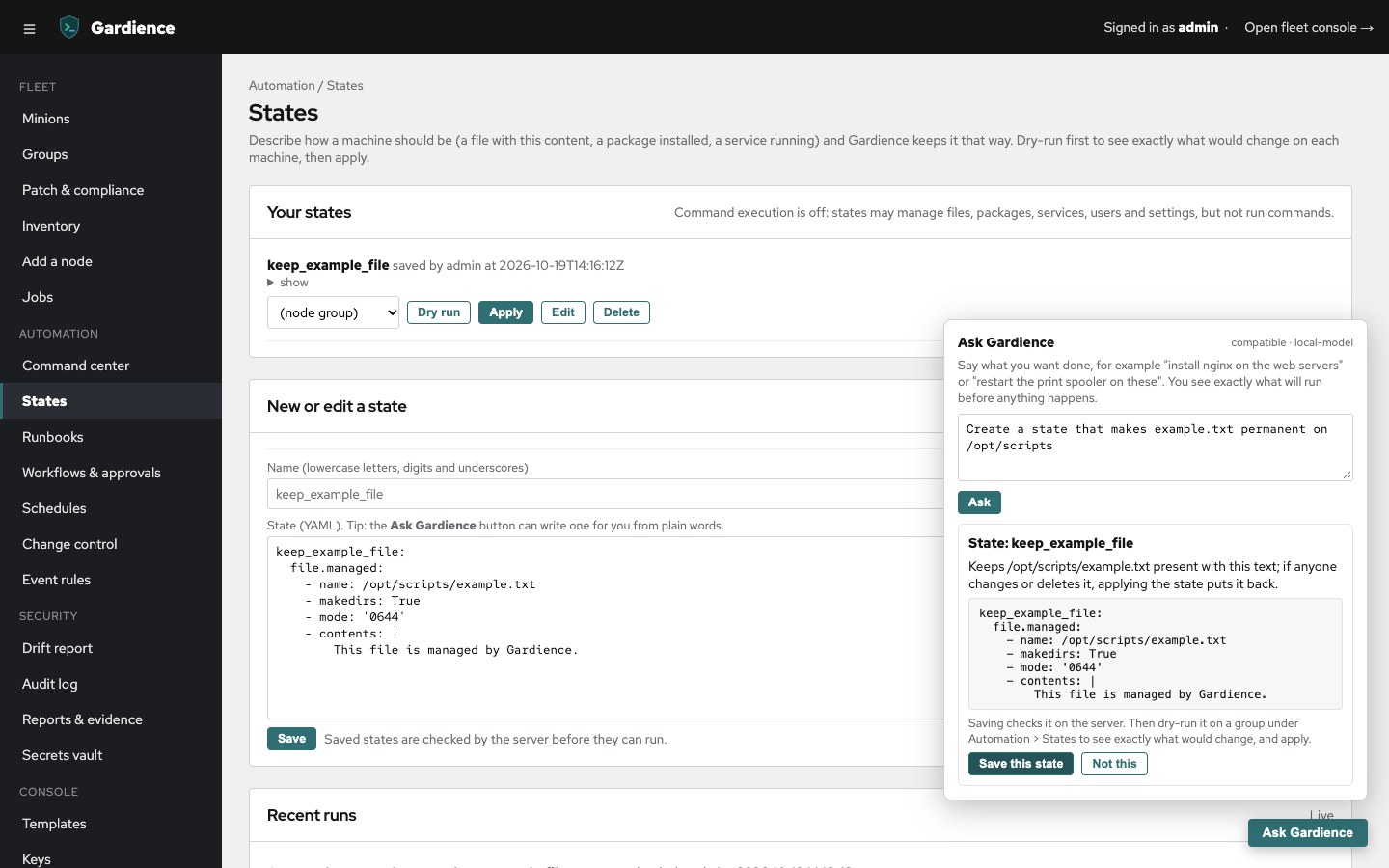
Ask Gardience, on every page
Plain English in, a checked proposal out: the exact call, the target machines, and a dry run before anything changes. It asks when something is missing instead of guessing.
It cannot go rogue
The assistant only proposes. It has no access to Salt, it can use only the commands your server allows, and its proposals pass the same checks as a person's input. A person presses Run, every time.
Your model, your network
Bring Claude, OpenAI, Azure OpenAI, or a model you host yourself, so nothing leaves an air-gapped enclave. Off until an admin turns it on. Gardience never sees your data.
Ask about your fleet
"Which servers need the most updates?" "What is exposed to this CVE?" With fleet lookups on, the assistant looks it up, read-only and as you, then answers with the machine names and the real numbers, and can propose the fix. An admin turns it on.
A briefing every morning
What changed overnight, what is exposed, what failed, and two or three suggested actions you can request in one click, by email or in Slack or Teams. The numbers come from Gardience itself, never from the model's guess.
Command center
Search every Salt command your machines offer in plain words ("install package", "add user"), read what it does, fill in a form, and see the exact Salt call before it runs. No syntax to memorize.
States, written for you
Describe how a machine should be and Gardience keeps it that way. Dry-run first to see what would change on each machine, then apply. Change it back by hand and the next apply restores it.
Your AI agents, governed
A built-in MCP server lets Claude, Cursor, or Copilot read fleet status, and request changes. Requests wait for a person to approve, under scoped keys limited to the groups you choose.