Every number on this site comes with its test: what was run, on what machines, the conditions, and the files to check it yourself.
What ran. On October 25, 2026 we built a test fleet on AWS for this run: 1,000 Amazon Linux 2023 servers (t4g.nano) and 20 Windows Server 2022 servers (t3.medium), managed by one Gardience server installed from the release bundle the way a customer installs it. These were test machines, not customer servers.
| Step | Result |
|---|---|
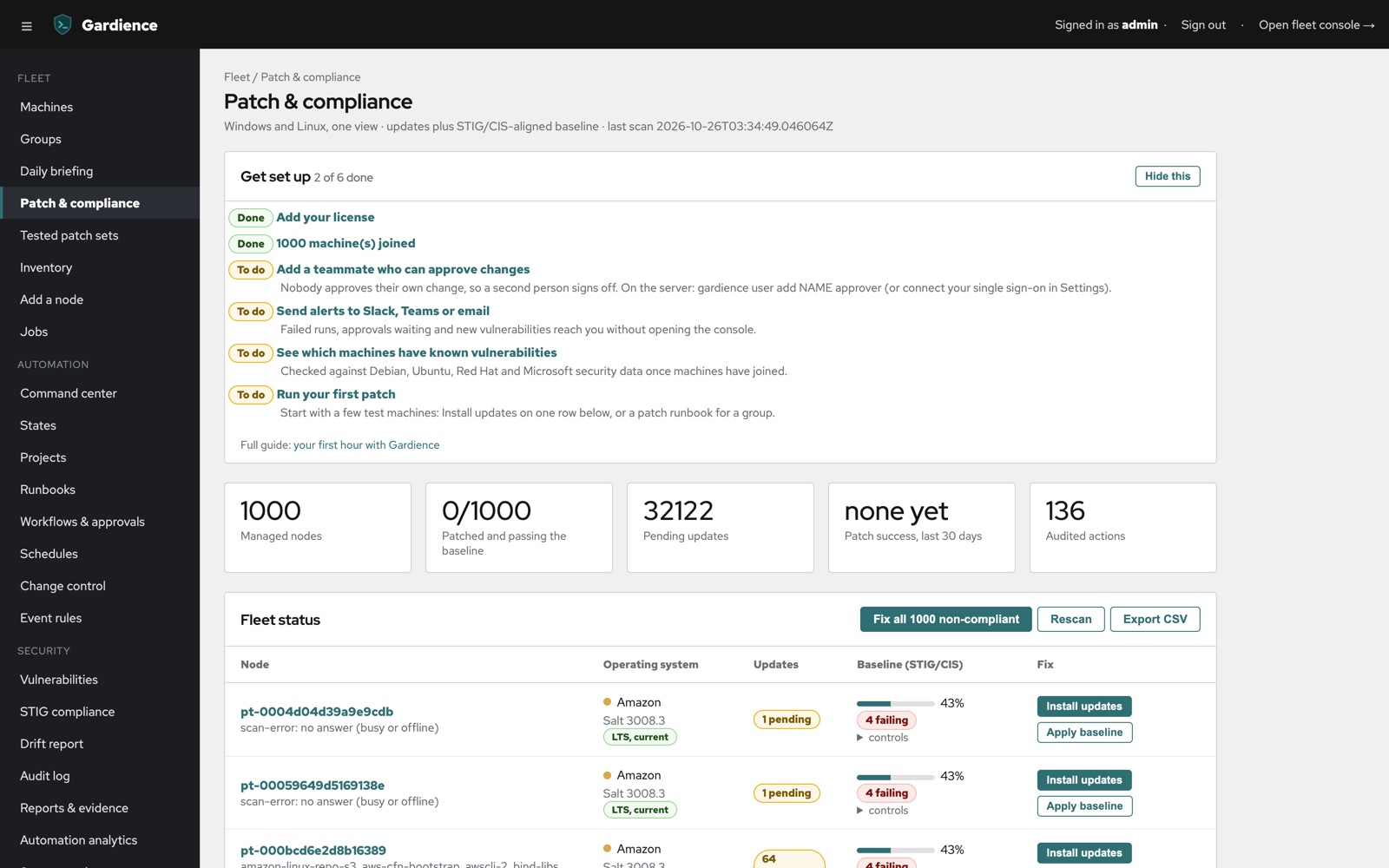
| Before, read straight from the Salt master | 1,020 machines answered, 64,000 updates waiting (64 per Linux server, a new kernel included) |
| Patch, requested by an operator and approved by a second person | 1,020 of 1,020 ok in 13 minutes. The requester's own approval was refused. |
| Reboot, requested and approved the same way | 1,020 of 1,020 answering again 4 minutes after the request |
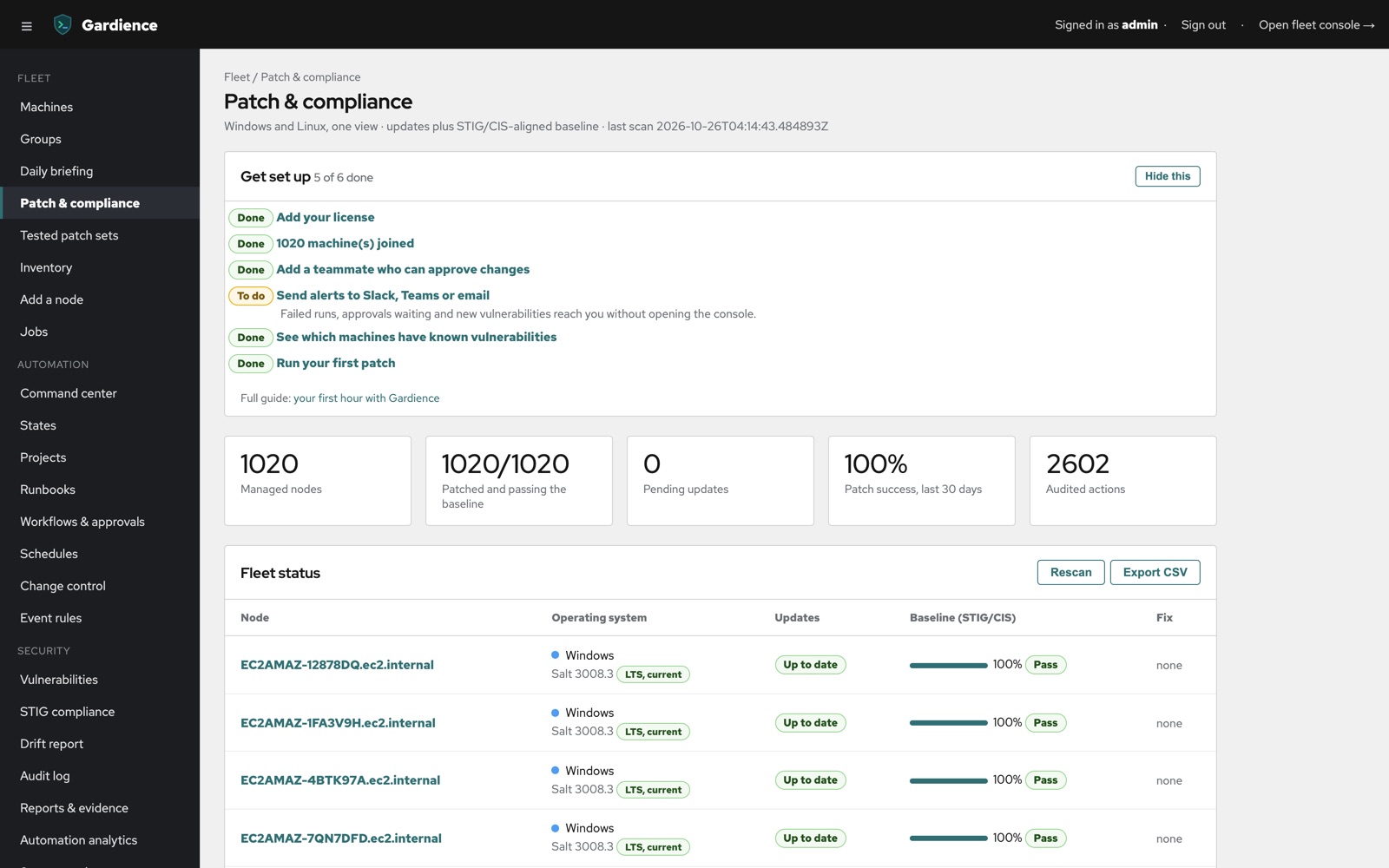
| After, read straight from the Salt master | 1,020 fully patched, 0 updates waiting, every Linux server on the new kernel |
| Security baseline on all 1,020 | 1,020 of 1,020 passing |
Check it: the run log, console before, console after, and the signed evidence pack exported from that server (Ed25519 signature, public key inside; 2,040 per-machine results, 0 failed). The servers were deleted after the run; it cost about $6.
What ran. On October 28, 2026: 50 fresh AWS machines, with 20 Windows Server 2022 and 2025 servers (with a TPM) as the enclave that holds controlled unclassified information. Gardience patched them, applied the CMMC settings and its security baseline, turned on FIPS mode, and encrypted all 20 system drives with BitLocker after each recovery key was in its vault (20 of 20). 35 minutes passed from the first step to a score of 110.
Check it: the run log, step by step with times.
Each command a playbook task sends goes to that one machine as a Salt job, encrypted with that machine's own key. Tested on real cloud machines, Linux and Windows, including a Windows playbook that writes a file with a secret from the Gardience vault.
What ran. The release key signs only a build that passed the full release check. Its security part runs a signed-in OWASP ZAP attack scan of every endpoint, nuclei, testssl.sh, nmap, Bandit, and Trivy, plus our own tests for sign-in tampering, permissions, sandbox escape, and audit-log forgery. The current release, 1.23.1, passed on November 1, 2026 with 0 failing.
Check it: how each release is tested and what the latest round found.
What ran. Every Windows Server release from 2016 to 2025, Windows 10 and 11, RHEL, Oracle Linux, Rocky Linux, SUSE, Ubuntu, Debian, and Amazon Linux, each with Salt 3006, 3007, and 3008 agents, joined a Gardience server on a real machine and ran its features: remote management, compliance scanning, the security baseline, patching, reboot and reconnect, and inventory.
Check it: the compatibility table, by platform and Salt release.
Gardience runs on your server, inside your network. It is not a cloud service: it sends nothing to us, and we have no access to it. The only exception is the optional Hosted plan, where we run a dedicated server for you, and the Security page says exactly what that means.