How the Gardience CVE tracker works on Windows and Linux
How Gardience tracks every CVE on every Windows and Linux server. Where the data comes from (Microsoft, Debian, Canonical, Red Hat family advisories, CISA KEV, and FIRST EPSS), how the list puts actively exploited CVEs first, and how one approved run fixes only the exposed machines.
Find and fix CVEs across the fleet
A new CVE drops and the first question is always the same: which of our servers have it? The Gardience CVE tracker answers that for every Windows and Linux machine in the fleet, every day, from the vendors' own security data. It puts the CVEs attackers are actually using at the top, and it fixes a CVE on only the exposed machines in one approved run.
Where does the CVE data come from?
#Every source is public, free, and published by the organization that owns the data. Gardience does not resell a paid feed or scrape anyone's website.
| Platform or signal | Published by | How Gardience gets it | How often |
|---|---|---|---|
| Windows and Windows Server | Microsoft, through its security update data (the MSRC API) | Downloaded by your Gardience server | Weekly |
| Debian | Debian's security team, through the Debian security tracker | Downloaded by your Gardience server | Daily |
| Ubuntu | Canonical, through its OVAL vulnerability data | Downloaded by your Gardience server, per Ubuntu release in your fleet | Daily |
| RHEL, Rocky Linux, AlmaLinux, Oracle Linux | Each distribution's own security advisories | Read by each machine from its own update repositories | Every check |
| Actively exploited CVEs | CISA, the Known Exploited Vulnerabilities (KEV) catalog | Downloaded by your Gardience server | Daily |
| Likelihood of attack | FIRST, through the Exploit Prediction Scoring System (EPSS) | Downloaded by your Gardience server | Daily |
Every download address can be changed in settings, so you can point Gardience at an internal mirror. On a network with no internet, an admin imports the files by hand and the tracker works the same way.
How does it check each machine?
#The work is split so machines stay light and the server never holds more than it needs.
- Windows. Each machine reports its build number and whether it is a server. Gardience checks that against Microsoft's data, where every fix names the Windows build that contains it. Windows Server and Windows 11 can share a build number with different fixes, so the two are kept apart.
- Red Hat family. Each machine reads its own distribution advisories and sends back only the CVEs it is exposed to.
- Debian and Ubuntu. Each machine sends its installed package versions, a few kilobytes compressed. The server checks them against Debian's tracker or Canonical's data in a small local index.
Every machine is checked once a day. Press Check all machines now after a big patch night or when a new CVE lands.
What goes to the top of the list?
#A fleet can easily show hundreds of CVEs. Our 8-machine test lab shows 212. The order matters more than the count, so the tracker sorts like this:
- Actively exploited. CVEs in CISA's KEV catalog come first, earliest CISA due date first. Each shows its due date and a ransomware tag when CISA lists it as used in ransomware campaigns. When an exploited CVE shows up on your fleet for the first time, Gardience sends one urgent alert.
- New on your fleet, with a fix. A CVE first seen in the last 14 days ranks next, even before the vendor rates it. PHP2Shell sat unrated for a day, and that is the day you want to be patching.
- Fixable, by likelihood of attack. The rest are ordered by EPSS, the chance a CVE is exploited in the next 30 days, then by severity, then by how many machines have it.
Alerts go to email, PagerDuty, or a Slack or Teams webhook.
How do you look up one CVE?
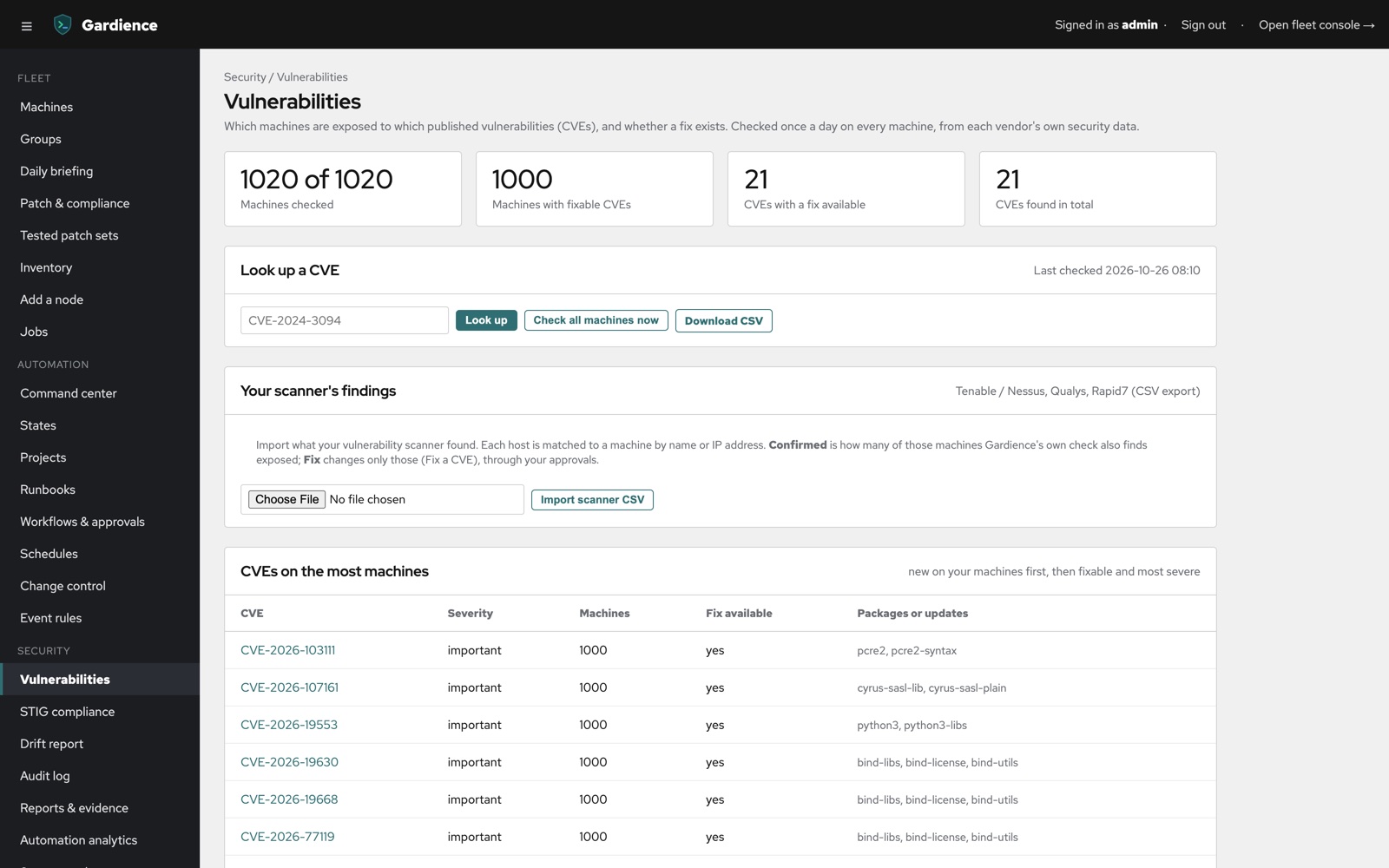
#Type the CVE into Look up a CVE. The answer is the list of exposed machines, whether a fix exists, which packages or updates carry it, its KEV status, and its EPSS score. Zero exposed machines is an answer too, and it is the one your boss wants in writing. Download CSV exports the full list with the KEV, CISA due date, ransomware, and EPSS columns for a report or a ticket.
Can it use my scanner's results?
#Yes. Import a CSV export from Tenable Nessus, Qualys, or Rapid7. Gardience matches each host to a machine by name or IP address and shows how many of those findings its own check confirms. That splits your scanner report into the findings Gardience can fix today and the ones that need a person.
How does it fix a CVE?
#Press Fix on a CVE. Gardience builds one run that installs only the updates for that CVE, plus anything they require, on only the exposed machines. Every other pending update stays pending. A second person approves the run, it lands in the tamper-evident audit log, and the next check shows zero.
We tested it at scale: 1,020 Windows and Linux servers patched in 13 minutes in one approved run, and 600 web servers exposed to PHP2Shell taken to zero (the test and the commands).
Why does this matter for CMMC?
#CMMC requirement 3.14.1 asks you to identify, report, and correct system flaws in a timely manner. The tracker covers the identify step every day, the KEV order and due dates show what "timely" means for the worst ones, and the approved fix runs and audit log are the evidence that you corrected them.
Questions
#Is the CVE data public?
#Yes. Microsoft, Debian, Canonical, the Red Hat family distributions, CISA, and FIRST all publish it for free. Gardience downloads it from them directly.
Does the CVE tracker need internet access?
#Not necessarily. With internet, your Gardience server downloads the data on its own schedule. Without it, an admin imports the same files by hand.
Which systems does it cover?
#Windows 10 and 11, Windows Server 2016 through 2025, Debian, Ubuntu, and RHEL 8 and later with its rebuilds (Rocky Linux, AlmaLinux, and Oracle Linux).
How is this different from a vulnerability scanner?
#A scanner finds problems and hands you a report. Gardience finds them from what each machine reports about itself, with no network scan, and then fixes them through your approvals. Many teams keep their scanner and import its results, so both sides agree on the same list.
See vulnerabilities for the overview, or start the free 90-day trial on up to 25 machines.
Find every exposed machine in your first hour
The free license covers 10 Windows and Linux machines with no end date: CVE matching with CISA KEV and EPSS, and a one-click fix for only the exposed machines, with approval.
Free 10-machine licenseFree 90-day trial (25 machines)How CVE matching works